
Monday, May 16, 2011

Sunday, January 23, 2011
Maus II!!!
In the article “On Spiegelman's Maus I and II” by Ian Johnston, discusses controversial issues about Maus (http://records.viu.ca/~johnstoi/introser/maus.htm). He wants to “stress that Maus I and II are not another Holocaust-survivor narrative, but are rather an attempt to confront a collateral issue: How does one make sense of a Holocaust narrative? Or, more particularly, how does one, as an artist and the child of Holocaust victims make imaginative sense of the Holocaust?”
He tries to found out who is the main concern of the essay, or who is the “hero”. He debates between Vladek and Artie. He argues that Vladek doesn’t have the characteristics of a main character. The fact that he can’t emotionally survive or grow through out the novel shows this very fact. He holds little concern over Artie and letting Artie cope with the loses. He has become in some ways desensitized by the whole experience. Artie on the other hand is much more complex than his father. In the article talks about how there is a major undercurrent of the “artist striving to give symbolic shape and narrative form to his family's experiences in order to cope with his own pain”. Maus II focuses on Artie’s struggle to “cope with his pain” by pointing out how he found it difficult to retell his fathers story with out under stating what truly happened there. Readers also see his pain as his work gained praise of people. He almost felt guilty over his accomplishments. All this points to the fact that Artie is the main character.
The article also talks about the “objection that a comic book is not a suitable artistic form for such a serious subject is a point of view we can (and should) respect, but not one we have to agree with.” It describes how we should not discount this as art work or literature just because it is a comic. It points out that it is a good way to keep past and present alive. It also helps us shape our responses toward the text. He can leave certain images to the readers, while he can also directly depict the images he wants readers to see.
Friday, December 10, 2010
Cat's Cradle and its Parallel to Postmodernism

Thursday, November 4, 2010
Governments- Passed and Present

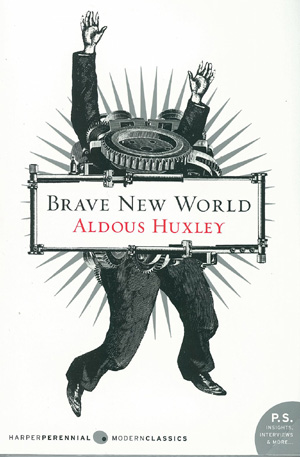 In our next essay I think it would be cool to write about a prompt that has to do with analyzing governments and how in Brave New World the government controls the people and how that compares to history as well as other texts. I would discuss how the government controls everyone by making them happy. They mind warp them to be satisfied with what their assigned job is. I would refer to Sir Ken Robinson’s youtube video, describing how the government gives them Soma to concentrate and be happy, he referred to todays world and how we give our children drugs to focus or not be depress, ext.
I would also bring in text about George Orwell’s 1984, and how he envisioned a future controlled by a government. I would talk about their similarities and how both governments control the way people think as well as having a lower class (prole- 1984, Savages- Brave New World ). I would also talk about their differences, for example how 1984 uses misery and fear, such as the fear of war, to control the people. Brave New World on the other hand uses happiness to control the people.
I would also bring in One Day in the Life of Ivan Denisovich, written by Aleksandr Solzhenitsyn, which describes the one day in the life of a Russian prison. I would tie in how this refers to a real life government. I would discuss how the government in this novel also tried to control its people, and they did it by taking away people from society and punishing them or killing them. I would talk about how this could lead up to the future and how it is similar to how in Brave New World they send people they are different from norm to islands where they can live their life out in freedom. Overall I think it would be a fun essay to write.
Friday, October 29, 2010
A Parallel To Brave New World
Sadly I forgot about the blog so I’m now doing it late. In Sir Ken Robinson’s Changing Education Paradigms, he touches on a lot of points that Brave New World has. On one of them he points out how adults and children have come to believe that they are not smart because they don’t match with societies claims as the standards of “smart”. They thus feel out of place. This happens in Brave New World. Barnard is often singled out because he doesn’t look like an Alpha Plus. Because he is so different, over time he has become more and more separated form society. He began to think differently because he wasn’t accepted by society. Barnard makes the comment, “the sight of her transfigured face was at once an accusation and an ironical reminder of his own separateness.” (Huxley 86) Because he is not excepted by society he is singled out and is made to feel out of place and odd. Both societies have forced their expectations on the people, when they don’t make the “grade” they are then left out and excluded. Robinson compares schools to factory lines. There is sector for each thing and the children get passed down the line from one thing to the next to “learn”. This is very similar to Brave New World, where children are created in an assembly line and are moved from one area to the next as they get older, “opening an isolated door he showed them racks upon racks of numbered test-tubes.” (Huxley 5) In these racks are embryos, right from birth they are grouped in sections and move from one place to the next. They are only seen as numbers, not real people. Both societies have kids coming out in batches, there is no individuality. Robinson say’s that through all this factory system that happens at the school, the children loose their divergent thinking skills. Divergent thinking, for him, is seeing a lot of possibilities to one question. Kids are taught to follow a certain way of thinking and problem solving. By doing this, the school is punishing “wrong” ways of answering or seeing things. The school verdicts what is right and what is considered wrong. In Brave New World, they teach the children by repeating things to them in their sleep. Over time they stop questioning things, they just repeat what they had heard from the recorder, even if they have no idea what it means. Overall our school system is moving closer and closer to Brave New Worlds society. The school has assumed the power to verdict how children should think and process things, similar to Brave New Worlds society.
Monday, October 18, 2010
Brave New World- Manipulation
In Brave New World by Aldous Huxley, Mustapha Mond in the third chapter says, "Wheels must turn steadily, but can not turn untended. There must be men to tend them, men as sturdy as the wheels upon their axles, sane men, obedient men, stable in contentment." He is referring to society and how a man need to make sure things stay on track so that it doesn’t go off their “axles”. In his eyes he believes that manipulating and developing people to fit their designed job is the only way to keep the wheels turning. The people, right at the moment of conception, are developed and trained to fit a certain style of life. They are trained to be happy in the life they are suppose to life.
 The Controllers are the men who tend to the wheels. Society views them as the people who keep the peace, but they are truly the once that are manipulating the people. They make the past look terrible. Mustapha Mond describes the past as a appalling, and inhabitable. “Home, home–a few small rooms, stiflingly over-inhabited by a man, by a periodically teeming woman, by a rabble of boys and girls of all ages. No air, no space; an understerilized prison; darkness, disease, and smells.” Through this description the children believe that they have evolved and are superior to the past. Yet they were only designed that way. Through the manipulation of science they were born to be “superior”. They are then trained and practically brain washed to except any of the ideas the government wants the children to believe in. They are expected to exert their emotions and feelings through desire, since “every one belongs to every one else”. It seems outrages for them to have an exclusive relationship with anyone. Most don’t understand the concept of family and restricting your self off to one person and then having emotional ties to that family. When Lenina tells Fanny that she has only been with Henry Foster for the last couple of months Fanny is in shock. She believes that isn’t healthy and encourages Lenina to try having other men as well. In Lenina’s society having that “exclusive” relationship with Henry is unnatural and frowned upon.
Sunday, October 3, 2010
Imperialism?
 In the discussions of the Tempest, one controversial issue has been that is supports imperialism. In Aime Cesaire’s rewrite a humorous version of the original The Tempest called A Tempest. He enhances the idea of Imperialism in the play, making Caliban look even worse than what is portrayed in the real play. Prospero describes him as “a savage… a dumb animal, a beast I educated, trained, dragged up from the bestiality that still clings to you.” In the Play, Cesaire illustrates how imperialism is such a big part of the play. On the other hand, George Will in his article Literary politics, expresses how many people read to far into literature. He feels that the tempest doesn’t have anything to do with Imperialism. He thinks that by people comparing The Tempest to imperialism “critics strip literature of its authority.” (112) Stephen Greenblatt on the other hand agrees with Aime Cesaire’s view of The Tempest and how it relates to Imperialism. He feels that the only way to truly understand literature is see how it applies to politics, and what is going on during that time period. This is the same philosophy he applies to The Tempest, “It is similarly difficult to come to terms with what The Tempest has to teach us about forgiveness, wisdom, and social atonement if we do not also come to terms with its relations to colonialism.” (115) Overall I agree with Greenblatt and Cesaire. Imperialism did play a part in The Tempest whether we want to acknowledge it or not. Imperialism was prominent during that time period and it is understandable that even Shakespeare was affected by it. I understand what George Will is saying. I often feel that some people look to far into literature to get its meaning, but for me The Tempest had a strong pull toward Imperialism.
Subscribe to:
Comments (Atom)